


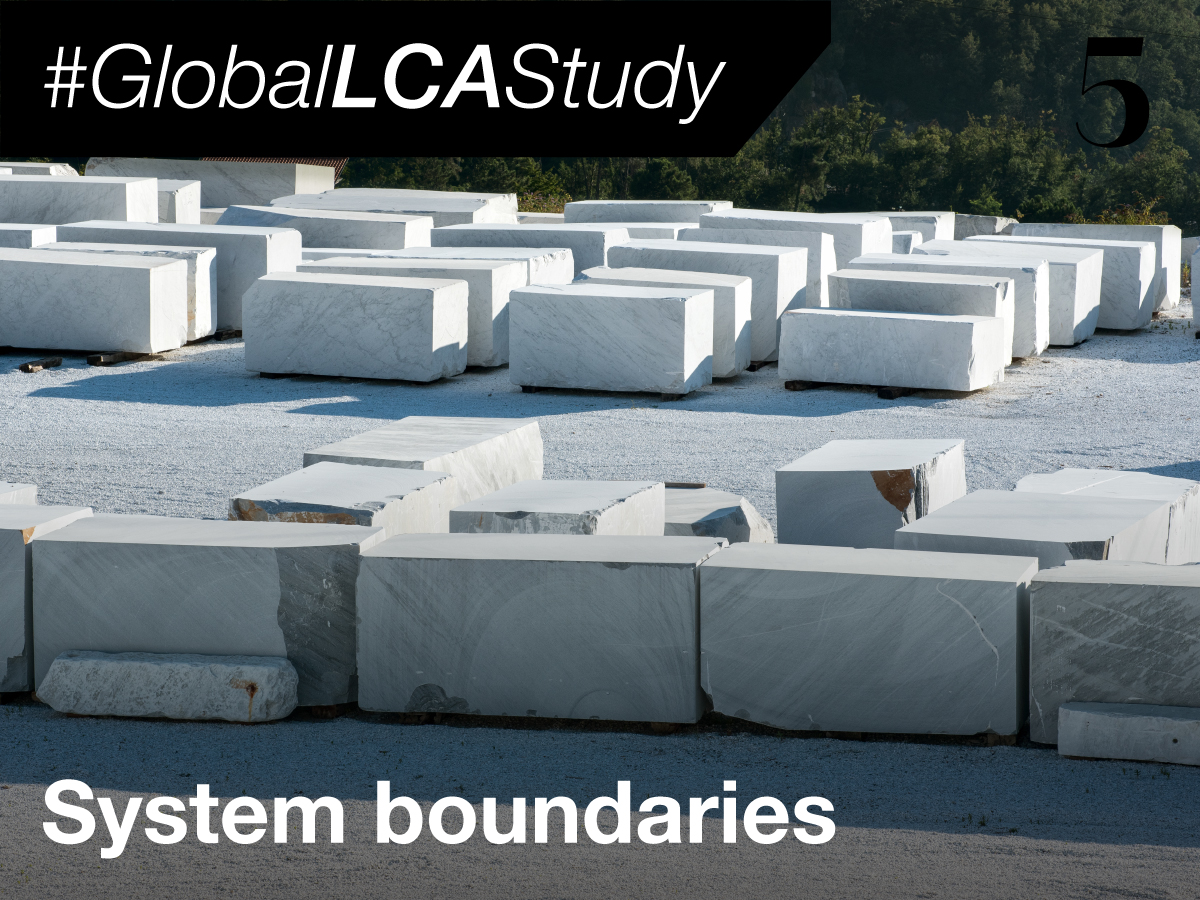
According to ISO 14040:2006, the Life Cycle Assessment (LCA) methodology is defined as an environmental management technique that enables the identification and evaluation of the potential environmental impacts of a product, process, or service throughout its entire life cycle—from raw material extraction to end-of-life management. The production process of natural stone slabs includes quarrying, sawing into slabs, and surface finishing. These phases define the so-called “system boundaries”, which delineate the production process assessed in the LCA study commissioned by PNA and carried out by the Politecnico di Torino. Defining these boundaries in advance is a critical and delicate decision, as it guides the entire data collection process required by international methodology.
In PNA’s study, 20 materials were analysed within these system boundaries—12 quarried in Italy and 8 abroad. For each material, evaluated at a size of 1 square metre and 2 cm in thickness, environmental impacts were calculated. These impacts extend well beyond the physical boundaries of quarries and processing facilities, covering the entire supply chain. This includes the production methods of key inputs such as diamond wire, explosives, discs, blades, and abrasives; the generation and distribution of electricity; and the use of transport systems—primarily road, but also maritime and rail for some materials. Additionally, internal operations at quarries and processing sites, such as extraction, block squaring, sawing, and surface finishing, were also included.
The climate change impact of the analysed slabs ranged from 5.1 kg CO₂ eq/m² to 36.7 kg CO₂ eq/m². This figure drops to a peak value of 12.3 kg CO₂ eq/m² when considering only materials sourced through the Italian supply chain. As a result, PNA companies were able to accurately quantify the average emissions impact of transporting slabs from abroad—amounting to 10.9 kg CO₂ eq/m². This is a significant contributor to the overall impact, particularly given the frequent use of long-distance road transport.
PNA has decided to continue its commitment to the sustainability of its production model by using the LCA not only as a tool for internal improvement but also as the basis for a future EPD (Environmental Product Declaration) certification for slabs produced entirely in Italy.
Focus interview
Giulia Pezzin, Laura Morvidoni and Isabella Bianco of Politecnico di Torino
“Improving energy management and reducing waste through monitoring technologies.”
How were the system boundaries defined, and how should the main findings be interpreted? How can technological and digital innovation contribute to reducing the environmental impact of natural stone slab production?
The system boundaries in the LCA study were defined to include the stages of quarry extraction, transport, slab sawing, and surface finishing. The average EPD value for the climate change impact of other natural stone materials is fully comparable to the results obtained in this study. Technological and digital innovation can play a key role in optimising production processes—improving energy management and reducing waste through advanced monitoring techniques.