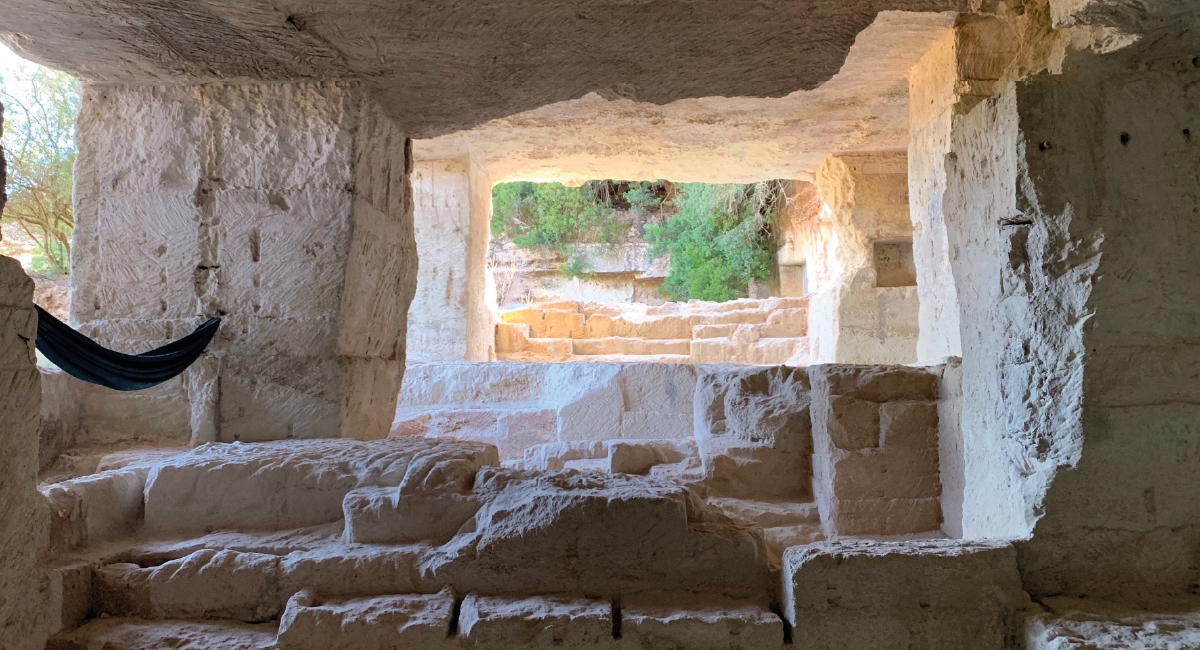
The director of the Architecture Biennale praises the project by Ensamble Studio carved into the marés stone of Menorca.
“Entering Can Terra is like wandering inside a cathedral of absence.” This is how Carlo Ratti, engineer and architect, director of the Venice Architecture Biennale, and professor at MIT in Boston and at the Politecnico di Milano, describes the space he inhabited and wrote about in a December 7 article in La Repubblica.
If Ratti speaks of a “modern ruin in reverse,” a “luxury campsite in a monumental, petrified tent,” the designers Anton García-Abril and Débora Mesa of Ensamble Studio simply call it “the house of the earth.” It is an abandoned marés-stone quarry in Menorca, transformed into an experimental cultural and living space with minimal intervention.
Beyond adding custom furniture, suspended walkways, beanbag chairs, and a modular kitchen, the site’s extractive logic, responsible for its clean orthogonal cuts, has been preserved: a sink and a shower tray were carved directly into the stone, while an old rainwater collection basin became a natural pool.
“The first surprise of Can Terra is how climatically comfortable it is,” says Ratti, impressed by the thermal-mass effect of the stone volume, which renders air conditioners or heaters unnecessary. “It is an important lesson for today’s designers: no matter how high the resolution, no LED screen can replicate the choreography of natural light”, nor, one might add, the power of natural stone.
Ratti praises “the intertwining of natural and artificial,” also citing Ensamble Studio’s Sunstone and Andrés Jaque’s Stonecrust, exhibited at the last Architecture Biennale: a suspended hemisphere made precisely with Can Terra’s stone, and a mosaic of rocks covered with bacteria. The architect notes that this sensibility is growing rapidly not only in architecture but across pop culture. “Contemporary design seems to flirt more and more with the primitive,” and stone presents itself as the perfect material to embody it. Ratti reflects, wondering “whether our bodies still ‘remember’ this type of dwelling […] like a distant echo of those Talayotic ancestors who once carved their lives into these stones.”
The director of the Biennale concludes that “perhaps this is precisely the deep appeal of Can Terra—and of the broader ‘paleo sensibility’ it evokes and encourages. In an era dominated by sparkling screens and digital interfaces, the roughness of stone is a welcome antidote.”
Photo Credits: Ensamble Studio