


The Touring Club Italiano and Associated Press praise the unique qualities of the stone which, from the quarries of Tivoli, built Rome and the Vatican and today continues to shape major architectural works across the globe.
The Touring Club Italiano, in its print magazine, recently devoted an in-depth feature to tiburtine travertine, lapis tiburtinus, the stone that built Rome and still enchants the world today. From the Le Fosse site, one of the oldest extraction areas in Tivoli, to the Acropolis of the Tiburtine city, a new itinerary promoted by the local administration recounts the story of a rock that has shaped monuments, infrastructures, and landscapes for over two thousand years.
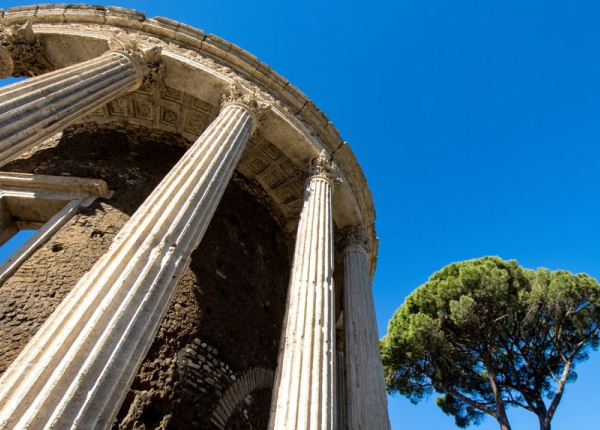
The Romans, fascinated by its light tones and mechanical strength, extracted travertine at the foot of the mountains of Tibur (today Tivoli) to erect buildings, temples, columns, floors, and cladding. "The material that more than any other helps define the character of Rome," as architect Paolo Portoghesi said, naturally also identifies Tivoli itself, with works such as the Temple of Vesta, with its circular podium and ten of its eighteen columns still standing, and the Mausoleum of the Plautii, beloved by artists and engravers, including Piranesi, who dedicated four of his engravings depicting Tiburtine monuments to the ancient tomb.
Travertine also marked the great works of Roman engineering: the Ponte Lucano, with its arches, Porta Maggiore, and the Ponte dell'Acquoria bear witness to Tibur's ability to combine grandeur and functionality. Archaeologist Fabiana Marino recalls how quarrying activity was placed under the protection of Hercules Saxanus, the deity "protector of those who worked the blocks" (saxa), confirming the importance of the stone for the city.
But the opus magnum in travertine is probably Bernini's colonnade of St. Peter's – built by selecting only the blocks with the most horizontal and resistant veining for its 284 columns, 140 statues, and 88 pillars. Yet even modern buildings in Rome such as the Great Mosque, the Ara Pacis, the Auditorium, and the New Congress Centre La Nuvola are the result of this rock.
Today, however, tiburtine travertine characterizes cities far beyond Rome: the latest megaprojects to employ it are King Salman Airport in Riyadh and the headquarters of the Popular Party in Shenzhen. Travertine is also quarried in Turkey, Iran, Mexico, and Morocco, but the stone of Tivoli features a unique hydrogeological circulation that grants it superior brightness and strength, not to mention its historical legacy.
Alongside the Touring Club, Associated Press has also recently praised the qualities of travertine in a video filmed in the quarry from which St. Peter's was born. In it, Sapienza professor Marco Ferrero explains that "travertine is like the Roman people: a humble stone, if you will, but solid and resilient. We can make this comparison: marble speaks to us in elegant, literary Italian, while travertine speaks to us in Roman dialect."

