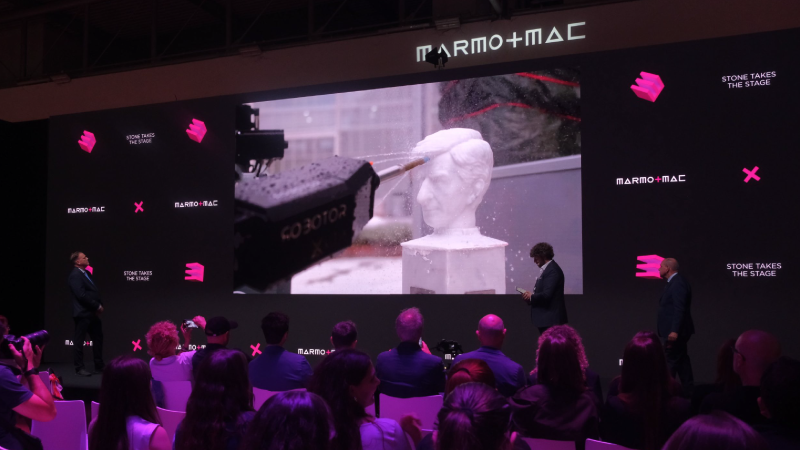
Awarded the Marmomac Best Communicator Award 2025, the artist celebrates — with irony — the symbolic power of Carrara marble.
Last September 26, Maurizio Cattelan sent his marble head to collect the Marmomac Best Communicator Award 2025. During the ceremony, a video was shown documenting the work of the robot on the artist’s portrait, accompanied by Cattelan’s audio commentary: “I’m sincerely flattered. Since I couldn’t be there in person, I decided to send my head, sculpted by a robot. […] In the meantime, I’ll take the credit.” A gesture that perfectly encapsulates his sharp irony and his ever-ambiguous relationship with authorship.
The work, made of Carrara marble through the use of advanced robotics, accepted the award granted to the artist for his use of the material in two sculptures from his exhibition Seasons, on view in Bergamo until October 26.
“The artist’s works,” stated the jury, “represent not only a moment of reflection on the cyclicality of life and history, on the transformations of the individual and society, but are the result of an extraordinary synergy between artistic intuition and advanced robotic technology, capable of generating a strong communicative and symbolic impact.”
Marble thus returns to the center of the path of an artist who, starting with All (2007) and later with the now-iconic middle finger in Milan’s Piazza Affari, L.O.V.E. (2010), had already chosen this material to engage with its millennia-old tradition — a thread that continues through the works Bones and November, part of the Bergamo exhibition.
In an interview with Silvia Nani for Corriere della Sera, the artist explained: “Marble carries an enormous symbolic weight: the history of art, the idea of eternity, of monumentality. Using it meant confronting that tradition, but also bending it to a different narrative.”
The artist emphasizes that the material is never neutral but imposes its own time and resistance: “You can’t command marble’s time. […] The illusion is that of challenging the centuries. True strength arises when concept and matter contradict each other.” Indeed, in his two recent works, the material itself is betrayed and reinvented: “In Bones, marble becomes a fragile body — a collapsed eagle that tells of the fall of power rather than its glory. In November, marble turns into water and into a paradoxical monument.” Thus, Cattelan “betrays his own tradition. From a symbol of eternity and grandeur, it becomes a vehicle of irony, fragility, even vulgarity.”