


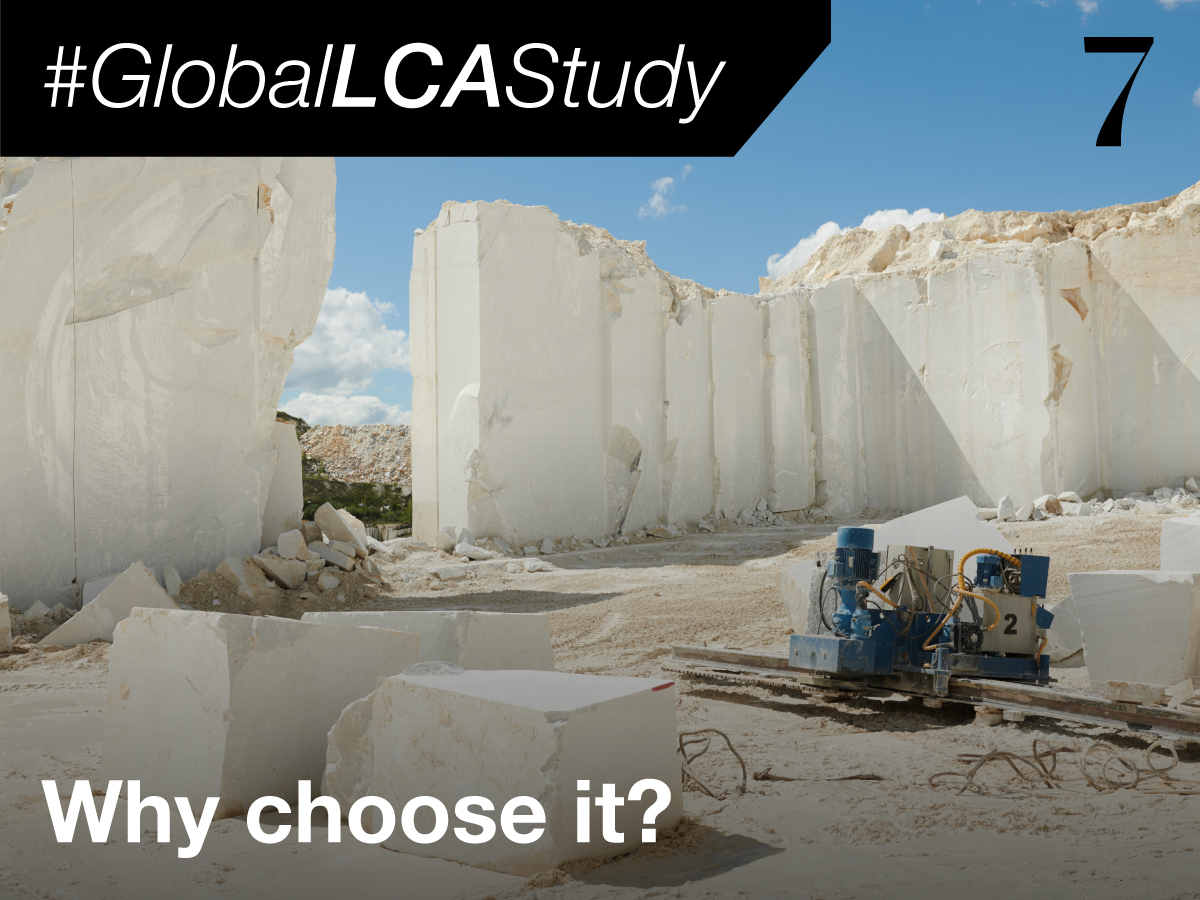
Through the internationally scaled LCA (Life Cycle Assessment) study on stone random slabs—no longer limited to the national level—the PNA (Pietra Naturale Autentica) business network has quantified the percentage contributions to the overall average environmental impact, as well as to individual environmental components, involved in the production of each 2 cm thick random slab with a surface area of 1 square metre.
The life cycle analysis enables quantification, for each random slab produced by the companies involved in the study, of the CO₂ emissions generated and therefore their contribution to climate change. The most significant data emerging from this analysis concern the ability to pinpoint the percentage contributions to climate impact attributable to each input material and each stage of the process, identifying, step by step, the respective contributions to consumption. While transportation significantly affects materials imported from abroad—with an impact ranging from 2.4 kg CO₂ eq/m² to 18 kg CO₂ eq/m² depending on the origin and mode of transport—energy consumption is impactful during both the extraction of blocks and their processing. For the extraction phase, energy-related impact varies from 0.13 kg CO₂ eq/m² to 13.7 kg CO₂ eq/m², while for the transformation phase, it ranges between 0.15 kg CO₂ eq/m² and 9.7 kg CO₂ eq/m².
This variability arises from the use of different energy sources for electricity generation. Some companies must generate electricity via diesel generators, which have a greater environmental impact than grid electricity. In other cases, electricity is sourced from environmentally low-impact means such as photovoltaic or hydroelectric power. Additional factors include the varying hardness and density of materials, differing technologies (e.g. explosive-based extraction versus diamond wire), and yield efficiency both in the quarry and the processing plant. For instance, a quarry with more fractured stone is likely to have a higher energy-to-usable-material ratio than one with higher yield.
Beyond these impacts, values have also been calculated for water consumption, usage of various process materials, and waste generation.
Focus intervista
Giulia Pezzin, Laura Morvidoni, and Isabella Bianco of the Polytechnic University of Turin, and Claudia Chiappino, Mining Engineer
“An X-ray of Natural Stone to Assess Its Sustainability and Practical Value”.
Can we affirm that natural stone is also advantageous from an environmental sustainability perspective?
Claudia Chiappino, Mining Engineer: “It has been observed that materials extracted and processed in Italy have a lower environmental impact compared to those imported from abroad. Moreover, the LCA study reveals environmental impacts comparable to other stone materials in the same sector. When it comes to alternatives such as ceramics, however, direct comparison proves more complex due to the need to account for various factors including product performance, useful life, maintenance requirements, and end-of-life treatment.”
How can this data provide useful insights for those involved in design and construction, particularly architects, designers, and engineers?
Giulia Pezzin, Laura Morvidoni, and Isabella Bianco, Polytechnic University of Turin: “The LCA—and even more so, the EPD (Environmental Product Declaration), which is a third-party certified LCA—represents a genuine ‘X-ray’ of the material’s sustainability profile. It aligns with Minimum Environmental Criteria (CAM) and other requirements in the construction sector, making it an essential tool, especially for designers.”