


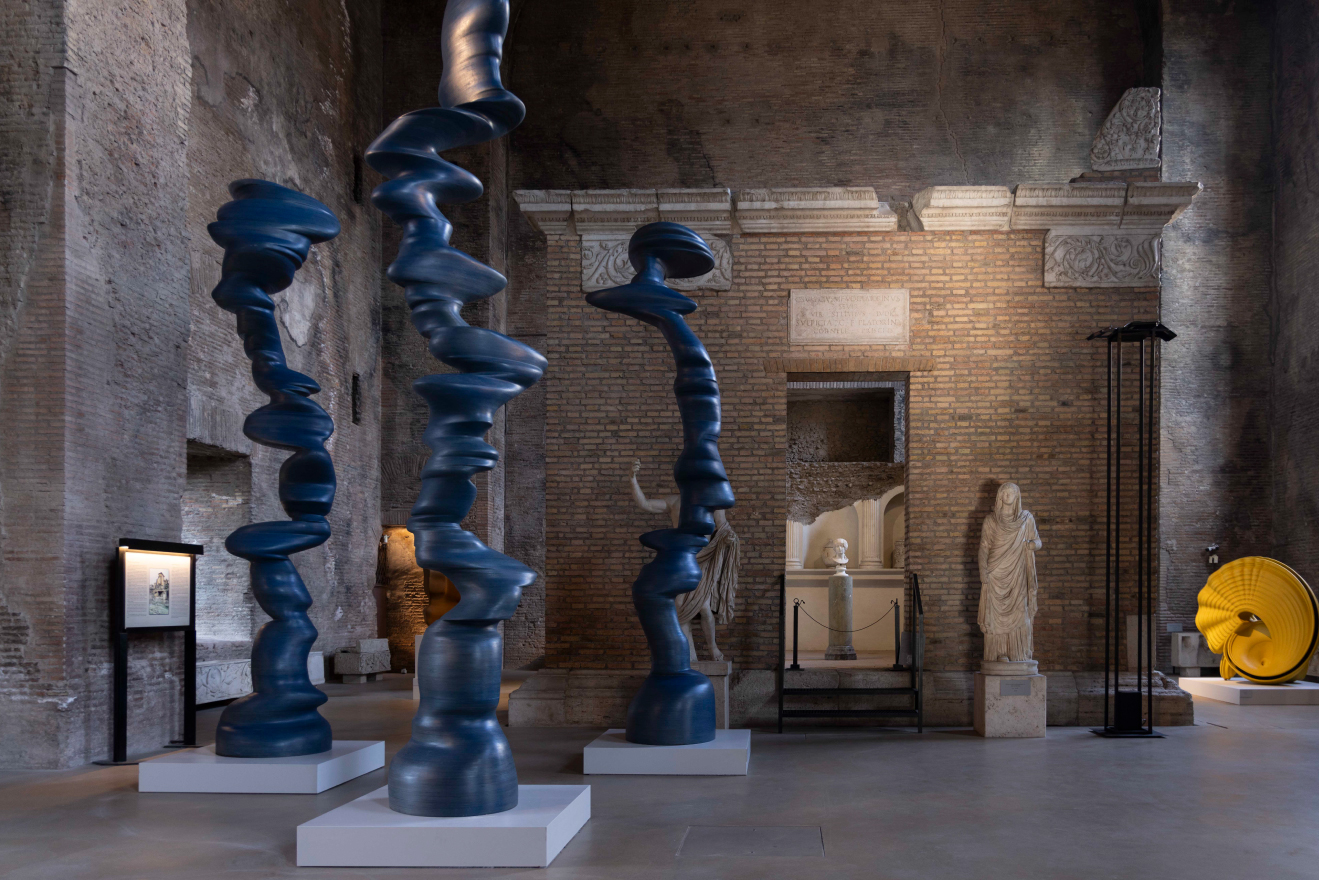
In the magnificent Baths of Diocletian in Rome you can visit until 4 May 2025 a solo exhibition of the famous British sculptor Tony Cragg, who places materials at the core of his work
The 4th-century monumental complex becomes the venue for the work of Tony Cragg, one of the most internationally acclaimed contemporary sculptors. Exploring the relationship between material and form, he uses both innovative and traditional materials to embody abstract shapes, often inspired by the human body, distorted and altered. In the Roman exhibition, an imposing travertine bust becomes the centerpiece, engaging in a dialogue between the contemporary and the ancient.
The heart of Rome hosts the exhibition of one of the most internationally renowned contemporary sculptors in a location that is more than fitting for the content in question. The solo show of Tony Cragg (Liverpool, 1949), Infinite forme e bellissime, presented by the National Roman Museum and curated by Sergio Risaliti and Stéphane Verger, occupies the monumental complex of the Baths of Diocletian, dating back to the 4th century. The artist is known for his dedication to the purely physical qualities of sculpture, understood as the relationship between material and form. The exhibition curator, Sergio Risaliti, speaks of a “search for ever new and unsettling forms, along with techniques and materials that Cragg studies and experiments with the curiosity and wisdom of a scientist-alchemist.” “Art is the only discipline that uses matter and materials in a non-utilitarian sense, solely to create new forms, new ideas, and new emotions,” adds the artist himself.
After beginning with assemblages of discarded objects (objets trouvés in artistic jargon), from the 1970s onwards, Cragg’s research has been almost entirely devoted to traditional materials, primarily bronze, wood, and stone. These are not merely a means to give shape to a subject, but the very subject of the works themselves, whose seemingly abstract forms aim to highlight the aesthetic and structural qualities of the materials in question. Seemingly abstract because, in reality, the starting point is often the human body, the core of the history of sculpture, which in the artist’s practice is distorted, multiplied, and altered to the point of becoming almost unrecognizable.


The exhibition includes a notable exception to this modus operandi, which is also an exception in terms of materials: it is the work Untitled (2019), an imposing bust over a meter tall, the only piece in stone among the 18 displayed. The sculpture, weighing 600 kg, is made of travertine, whose texture contrasts sharply with the monochromatic and matte surfaces of the other works in bronze, steel, or fiberglass, or with the uniform texture of those in wood. It is also the only piece without a title (the others are quite eloquent: Caught Dreaming, McCormack, Red Figure, Lost in Thought, Points of View, for example), which is paradoxical given that it is the only one with a clear subject – a slightly deformed face with a classic profile that is immediately identifiable.
While the spaces of the baths are perfect for hosting Cragg's grand and dynamic sculptures, it is certain that these generate a – intentional and successful – conflict with their context. Untitled (2019) then assumes the role of being the only point of contact between these two worlds: the contemporary world of abstract and ethereal forms, and the ancient world of noble and massive architecture and sculpture. The choice to display only one work in stone cannot be unintentional, given the frequency with which the artist works with the material and its direct symbolic relationship with the history of the city hosting the exhibition. The bust thus takes on great importance and becomes the focal point of the entire exhibition, emphasizing the differences and similarities between two artistic spheres that are so distant yet always fascinating.
As Risaliti explains, "Cragg has a special sensitivity and a solid knowledge of art history, which allows him to attune to the environments that welcome his sculptures, managing to make his forms resonate in new contexts without causing discomfort or cacophony. This is a sign that his inspiration comes from afar, even though it is deeply rooted in the present." This is perhaps a prerequisite for anyone today who wishes to approach sculpture through a noble and meaningful material like travertine and make it dialogue with the origins of their own history, namely with the classical elements that permeate the grand halls – originally adorned with white marble – of the Baths of Diocletian.
To find out more visit https://museonazionaleromano.beniculturali.it/evento/tony-cragg-infinite-forme-e-bellissime/
Photo Credit: Monkeys Video Lab