


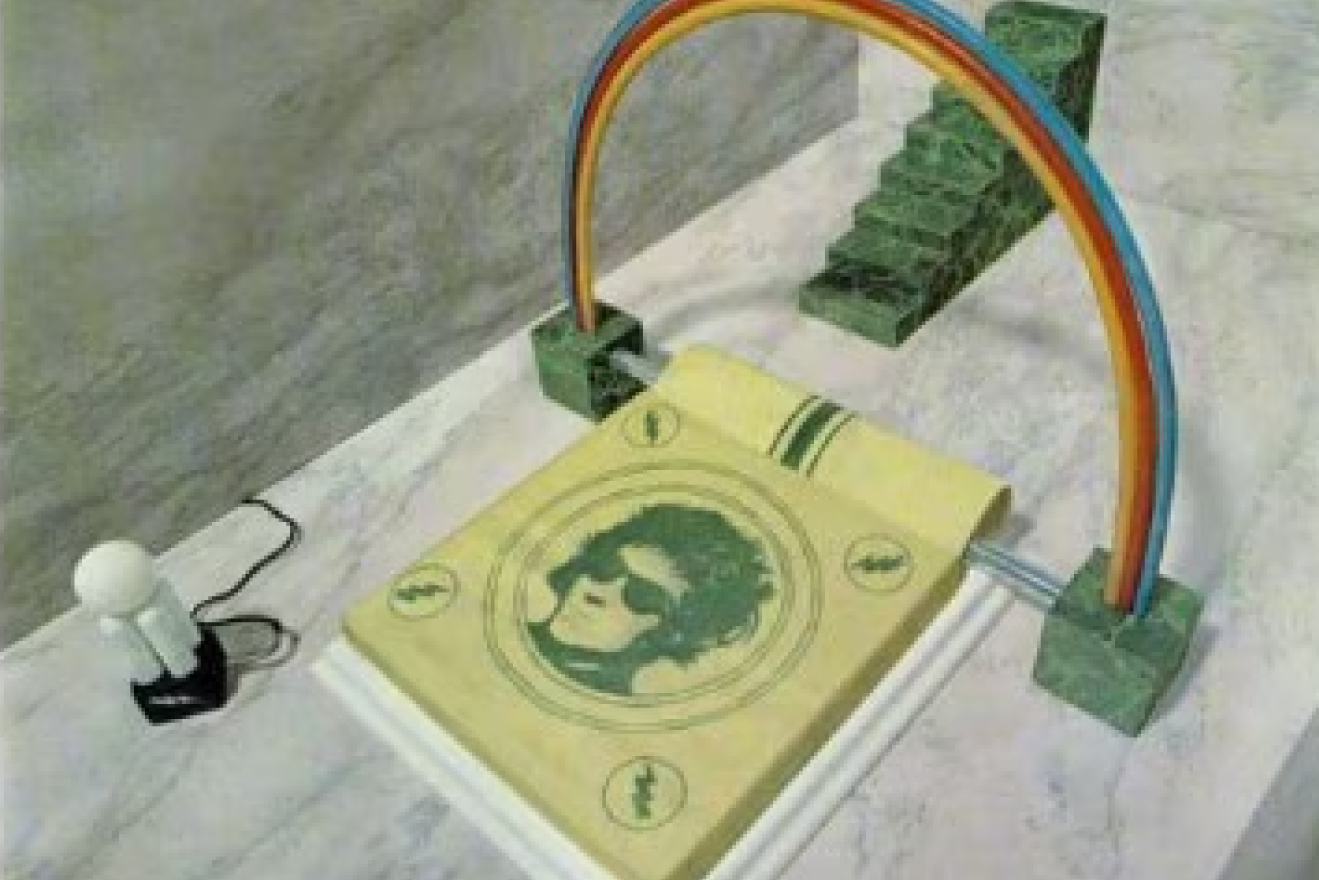
A focus on Archizoom’s Rainbow Bed, featuring a bedsheet with Bob Dylan’s face and bedside tables made of green marble
On the occasion of the collective’s feature in Domus magazine in 1967, Archizoom designed four beds at a 1:10 scale, employing their typical eclectic language in an exercise of radical design. The project also incorporated the iconic Tuscan stone, celebrated for its role in architectural history from the Romanesque to the modern era.
Coinciding with the January 23 cinema release of the film A Complete Unknown about Bob Dylan, the prestigious architecture (and much more) magazine Domus published an article showcasing “Bob Dylan-mania” through 10 works and design objects. Among these stands out Archizoom’s Rainbow Bed, thanks to its bedsheet bearing the singer’s face, a rainbow-shaped headboard, a rotating mechanism to adjust the pillows, and two green marble cubes serving as bedside tables.
The explosive combination of such expressive and contrasting elements is the hallmark of Archizoom, an Italian collective of architects and designers founded in Florence in 1966 by Andrea Branzi, Gilberto Corretti, Paolo Deganello, and Massimo Morozzi. Their significant impact stems from their ability to merge art, industry, and politics into projects that are as visionary as they are ironic, leaving a mark on modern architecture and design history. Notable examples include the utopian No-Stop City (1970; an infinite city of standardized elements) and the iconic Superonda armchair (1967; a single polyurethane block shaped like an “S”).
In 1967, Ettore Sottsass tasked each member of the collective with designing a 1:10 scale bed for the group’s presentation in issue 455 of Domus. Archizoom unleashed their creativity, incorporating metal, taxidermy, sci-fi lamps, pop icons, and, notably, marble. This material was used not only for the bedside tables but also, at times, for walls and floors. The Rainbow Bed’s room even featured a monumental staircase apparently carved from a massive block of green marble.
This unmistakable material, along with alberese stone and Carrara marble, forms the bichromatic scheme that is a cornerstone of Tuscan Romanesque architecture. It is ubiquitous in Florence (Archizoom’s birthplace), particularly in the Duomo, the Baptistery, and the façade of Santa Maria Novella.
However, the same green marble from Prato was later used by Mies van der Rohe in several seminal projects, from Berlin’s Neue Nationalgalerie to the Barcelona Pavilion. From that point onward, the material became part of the modernist imagination, likely the reason why the collective paired it with Bob Dylan.
Through their conceptual projects, Archizoom interpreted the consumer and image-driven society, responding – in Andrea Branzi’s words – with an “aggressive, closed objectuality of opposition, imposing itself on its surroundings through the power of its language.” By employing green marble, they not only paid homage to a material tied to their Tuscan roots but reaffirmed its undeniable status as a cultural icon.
Fonte articolo e immagini: https://domusweb.it/it/design/2025/01/16/bob-dylan-oggetti-design.html